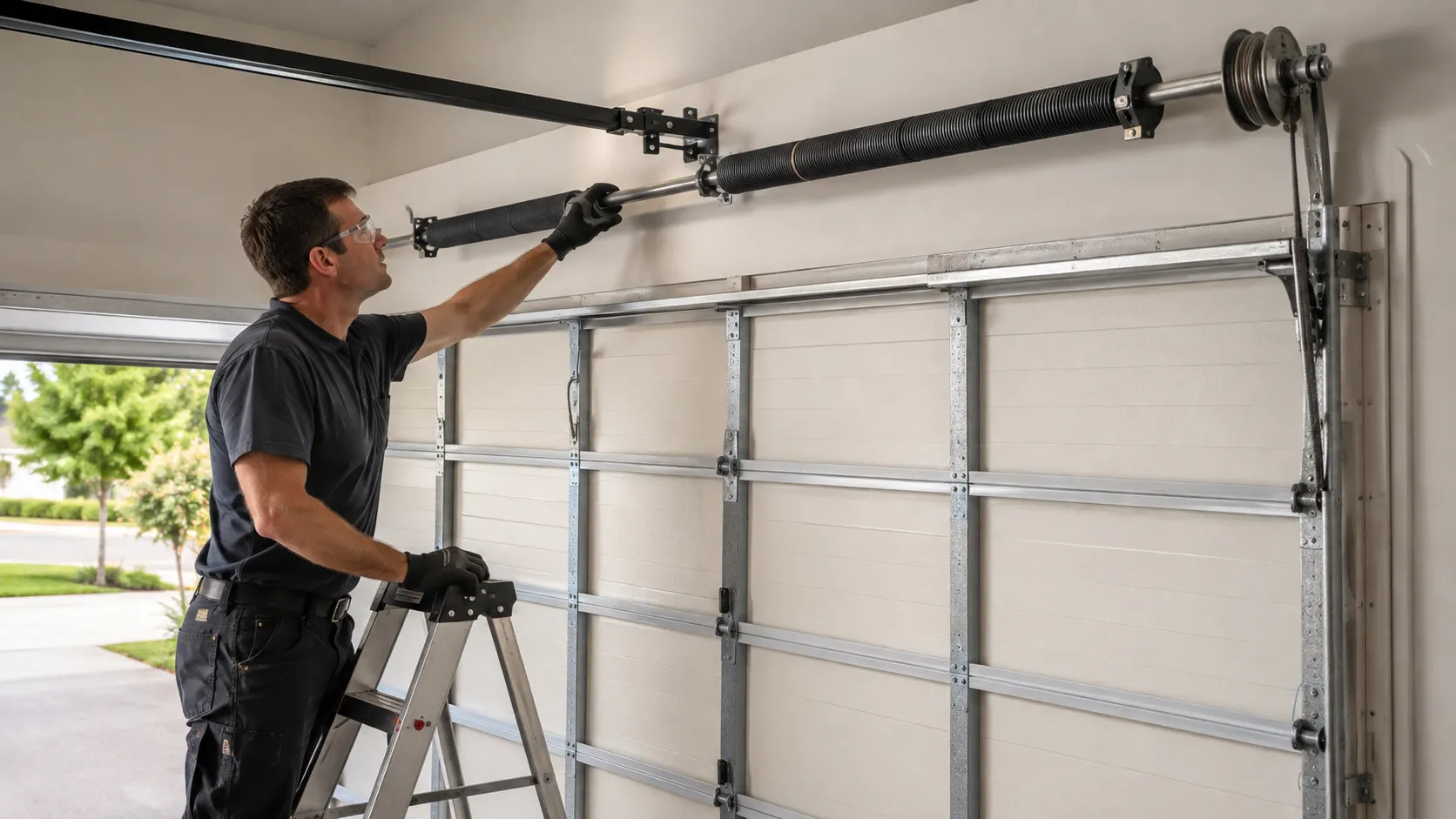
If your opener goes dead during a power cut and the door won't move by hand either, stop pulling on the emergency release cord and call someone. That cord disconnects the carriage from the drive so you can lift the door manually - if it's already disconnected and the door still won't budge, you're likely looking at a spring problem, not an opener problem, and that's not a DIY fix.
If the opener runs but the door doesn't move, or it moves and reverses halfway, that's usually the opener itself: worn gear, a dying capacitor, or a logic board that's had enough. Given how much of Venice's housing dates to the 1964-1999 window, a lot of these units are on their second or third motor already, and parts for the oldest chain-drive models can be hard to source.
Call before a storm forecast, not during one. If your opener has no battery backup and you're relying on it to get the car out ahead of weather, that's worth fixing on a normal Tuesday, not at 6am when the sky's turning.
The Situation
Across the 22 named areas that make up this part of the county, most houses went up between 1964 and 1999, with the median build year landing around 1979. That's a long run of construction, but it means a huge share of garage doors were fitted with openers designed for a much simpler electrical world - no battery backup, no smart connectivity, sometimes not even a working keypad anymore.
With 61,549 households and 37,668 owner-occupied houses in the service area, the sheer number of original or first-replacement openers still in service is not small. A door installed in a house built in 1979 has likely had its opener swapped once, maybe twice, but the wiring behind the wall and the wall switch itself are often original.
That matters when the power drops. An opener with no backup battery is just dead weight until the power's back, and the manual release becomes the only way in or out by that bay. Knowing where that release cord is, and that it actually works, is worth five minutes now.
What Local Conditions Do
Venice sits in a mild temperate band. That's actually good news for openers - you're not dealing with the freeze-thaw cycling that seizes gears and cracks housings further north, and you're not baking motors through repeated extreme heat swings either. The climate here is not the thing wearing your opener out.
Age is. A unit installed when a 1970s or 1980s house was built, or even a replacement bought in the 1990s, is simply old. Chain-drive motors from that era were built to run a door, not to survive a decade of Gulf-side humidity and salt-tinged air sitting in an unconditioned garage. Corrosion on contacts and a slow buildup of gunk on the drive rail do more damage over time than any single weather event.
So when the power cuts and the opener won't come back on its own even after power's restored, it's rarely the outage that killed it. It was already close, and the outage was just the last straw. That's a distinction worth knowing before you assume a surge protector will fix everything.
Where People Go Wrong
The most common mistake is treating opener failure and door failure as the same problem. They're not. A door that won't lift by hand, even after the release cord is pulled, points to spring tension - that's a different repair and a more dangerous one to touch yourself.
Second mistake: nobody looks for the manual release cord until the power's already out and they're standing in the dark trying to find it. If you own a house built anywhere in that 1964-1999 range, go find it now, know which way it pulls, and make sure it hasn't rusted stuck.
Third: assuming a battery backup unit is standard. It isn't, and it never was on the original builds from this era. If you want the door to open during an outage without hand-cranking it, that's an upgrade you have to buy, not a feature that came with the house.
Last, at a median household income of $77,359, a lot of owners here can reasonably budget for a modern opener swap instead of stringing along a 30- or 40-year-old unit through another storm season. Replacing beats repairing once the motor's original to the house.
How it works
From “it’s stuck” to “it’s fixed”
01
Tell us what’s wrong
Describe the symptom - won’t open, loud bang, opener runs but the door won’t move.
02
On-site diagnosis
A technician tests the door under power and by hand and finds what actually failed.
03
Clear, up-front plan
You get the fix that’s needed and what drives the cost - before any work starts.
04
Repaired & tested
The repair is done, the door is set true and tested, and the work area left clean.
Serving Venice, FL - tell us what your door’s doing and we’ll take it from there.
My opener won't work after a power cut but power is back on - what now?
If power's confirmed restored to the outlet and the opener still does nothing, the outage likely wasn't the real cause - it just finished off a motor or board that was already failing. Check the wall switch and breaker first, but if those are fine, the opener itself needs a look.
Do older Venice homes have battery backup openers already?
Not as standard. Most houses in this area were built between 1964 and 1999, well before battery backup was common on residential openers. If your opener is original or an early replacement, it almost certainly runs on power alone.
Is it worth repairing a 1980s-era opener instead of replacing it?
Usually not once the motor itself is the problem. Parts for chain-drive units from that period are getting scarce, and a new opener with backup power costs less over time than repeated service calls on a 30-plus-year-old unit.
Ready to get your garage door sorted?
Tell us what it’s doing and where you are in Venice - we’ll take it from there.